

Nanofiber Filter Media Market to Reach USD 2.85 Billion by 2035 at 9.7% CAGR | Transparency Market Research
Nanofiber Filter Media Market
Growing demand for advanced air and water filtration solutions is set to drive the nanofiber filter media market at a 9.7% CAGR through 2035.
Nanofiber technology is transforming filtration efficiency, enabling industries to meet stricter environmental standards while improving performance and sustainability.”
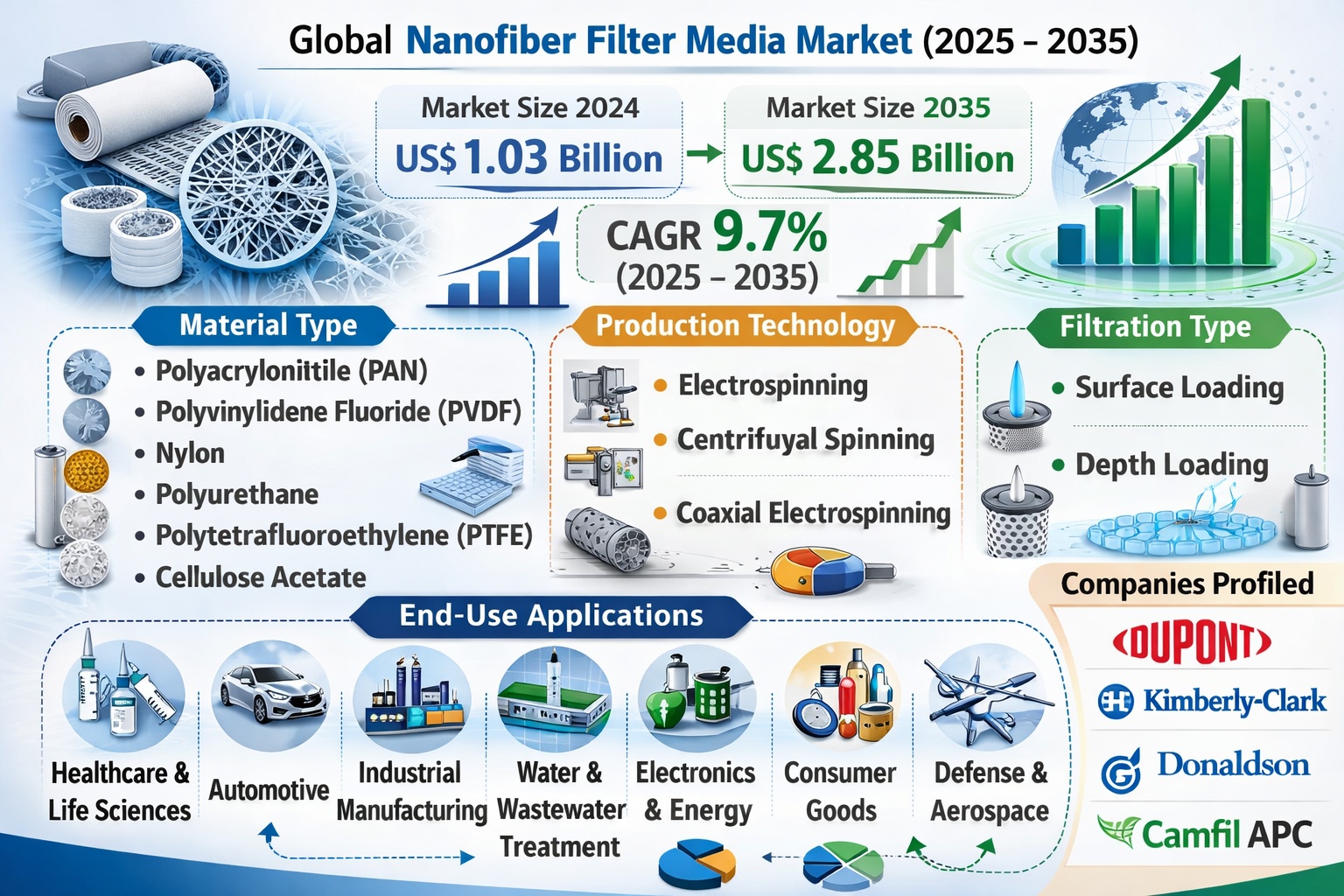
WILMINGTON, DE, UNITED STATES, February 20, 2026 /EINPresswire.com/ -- The global nanofiber filter media market is emerging as a cornerstone of next-generation filtration technologies, addressing rising global concerns related to air pollution, water contamination, and industrial emissions. Valued at USD 1.03 billion in 2024, the market is projected to reach USD 2.85 billion by 2035, expanding at a strong CAGR of 9.7% from 2025 to 2035.— Transparency Market Research
Nanofiber filter media consist of ultra-fine fibers typically produced through electrospinning or melt-blowing engineered into highly porous nonwoven layers. These materials provide superior filtration efficiency, low pressure drop, and enhanced contaminant capture, particularly for submicron particles. Their growing adoption across healthcare, automotive, industrial, HVAC, water treatment, and cleanroom applications reflects the critical need for high-performance filtration solutions in a regulation-driven global environment.
Don’t miss out on the latest market intelligence. Get your sample report copy today @: https://www.transparencymarketresearch.com/sample/sample.php?flag=S&rep_id=86870
Market Overview
The nanofiber filter media industry has witnessed accelerated expansion due to tightening environmental regulations and increasing awareness of air and water quality standards worldwide. Governments and regulatory agencies are enforcing stringent emissions norms and particulate control mandates, compelling industries to upgrade filtration systems.
Nanofiber media offer distinct advantages over conventional filtration materials:
• Higher surface area-to-volume ratio
• Fine pore structure for ultrafine particle capture
• Low airflow resistance
• Improved energy efficiency
• Compatibility with hybrid multilayer composite systems
In 2024, Asia Pacific dominated the market, accounting for approximately 49% of global revenue, supported by a strong manufacturing ecosystem and rapid regulatory enforcement in China, Japan, India, and South Korea. Among materials, nylon (polyamide) held the largest share at 40%, owing to its mechanical strength, scalability, and cost-effectiveness.
Key Drivers of Market Growth
1. Stringent Environmental Regulations
Global environmental policies such as the U.S. Clean Air Act, the EU REACH directive, and National Ambient Air Quality Standards (NAAQS) are driving demand for advanced filtration systems capable of capturing fine particulates and hazardous emissions. Industrial manufacturers, automotive OEMs, and municipal water authorities are increasingly adopting nanofiber-based solutions to ensure compliance.
Failure to meet regulatory standards can result in significant penalties, reputational damage, and operational disruptions. Nanofiber filter media offer reliable compliance by capturing ultrafine particles while maintaining low pressure drops.
2. Rising Air and Water Quality Concerns
Urbanization, industrialization, and population growth are intensifying pollution levels globally. Increasing awareness among consumers regarding indoor air quality (IAQ), especially post-pandemic, has fueled demand for high-efficiency HVAC filters, cabin air filters, and portable air purifiers incorporating nanofiber layers.
Water utilities are also deploying nanofiber membranes to address microplastics, pathogens, and chemical contaminants in drinking water systems.
3. Technological Advancements in Manufacturing
Electrospinning, centrifugal spinning, and coaxial electrospinning technologies have matured significantly, enabling scalable production with enhanced uniformity and cost efficiency. Innovations now allow manufacturers to fine-tune fiber diameter, porosity, and mechanical properties, optimizing filtration performance for diverse applications.
Smart filtration technologies integrating antimicrobial coatings, self-cleaning capabilities, and real-time monitoring sensors are also transforming the industry landscape.
Key Players and Industry Leaders
The global nanofiber filter media market features a mix of established filtration leaders and advanced materials innovators. Prominent companies include:
• DuPont de Nemours, Inc.
• Kimberly Clark Corporation
• Donaldson Company, Inc.
• Camfil APC
• Freudenberg Performance Materials
• 3M Company
• Parker Hannifin Corporation
• Toray Industries, Inc.
• Hollingsworth & Vose Company
• Pall Corporation
• Mann+Hummel
• Nederman
• Helsa-Automotive GmbH
• Cummins
These players are focusing on R&D investments, strategic partnerships, capacity expansion, and sustainable material innovation to strengthen their competitive positioning.
Recent Developments
Recent industry activities reflect aggressive scaling and technological advancements:
• Toray Industries expanded air filter production capacity in India (Sri City) in 2025 to support rising demand in automotive cabin filtration and air purification.
• Elmarco hosted industry events alongside EXPO 2025 in Osaka, promoting industrial-scale nanofiber production using Nanospider technology.
• Hollingsworth & Vose introduced PlusZero, a PFAS-free filtration portfolio addressing evolving regulatory requirements in North America and Europe.
• MANN+HUMMEL launched FreciousPlus cabin air filters featuring nanofibers for BMW aftermarket models, demonstrating growing adoption in passenger vehicles.
Such initiatives signal accelerating commercialization and technological maturity across the sector.
👉 Full Market Report available for delivery. For purchase or customization, please request here – https://www.transparencymarketresearch.com/sample/sample.php?flag=S&rep_id=86870
New Opportunities and Challenges
Opportunities
• Expansion in cleanroom and semiconductor manufacturing filtration
• Growth in healthcare PPE and medical device applications
• Increasing demand for sustainable and biodegradable nanofibers
• Adoption in electric vehicles and advanced HVAC systems
• Integration of smart monitoring technologies
Challenges
• High initial capital investment for electrospinning scale-up
• Regulatory scrutiny of nanomaterial safety
• Supply chain volatility for specialty polymers
• Performance validation cycles in automotive and healthcare sectors
Companies are mitigating these challenges through localization strategies, hybrid composite development, and regulatory compliance frameworks.
Market Trends & Innovations
Key trends shaping the industry include:
• Rapid transition toward PFAS-free filtration materials
• Growing use of biodegradable polymers
• Integration of graphene and carbon nanotube-based hybrid structures
• Increasing adoption of antimicrobial and antiviral coatings
• Development of self-cleaning and reusable filter media
Nylon (PA6/PA66) continues to dominate material adoption due to its excellent balance of filtration efficiency, mechanical strength, scalability, and compatibility with PET and PP substrates.
Future Outlook
The nanofiber filter media market is poised for sustained high-growth momentum through 2035. Asia Pacific will continue to lead in volume-driven expansion, supported by robust industrial manufacturing and regulatory enforcement. North America and Europe will emphasize premium, specification-driven adoption in cleanrooms, pharmaceuticals, and advanced manufacturing.
As sustainability priorities intensify, biodegradable nanofibers and energy-efficient filtration solutions will gain prominence. Continuous innovation in smart filtration and hybrid materials will unlock new application frontiers, reinforcing the market’s long-term growth trajectory.
Market Segmentation
By Material Type
• Polyacrylonitrile (PAN)
• Polyvinylidene Fluoride (PVDF)
• Nylon (Polyamide)
• Polyurethane (PU)
• Polytetrafluoroethylene (PTFE)
• Cellulose Acetate
• Others
By Production Technology
• Electrospinning
• Centrifugal Spinning
• Coaxial Electrospinning
By Filtration Type
• Surface Loading
• Depth Loading
By End-use
• Healthcare & Life Sciences
• Automotive
• Industrial Manufacturing
• Water & Wastewater Treatment
• Electronics & Energy
• Consumer Goods
• Aerospace & Defense
By Region
• North America
• Europe
• Asia Pacific
• Latin America
• Middle East & Africa
👉 to buy this comprehensive market research report, click here @: https://www.transparencymarketresearch.com/checkout.php?rep_id=86870<ype=S
Key Trends for the Future
• Increased adoption in electric vehicle cabin filtration
• Rising integration into smart building HVAC systems
• Expansion in water purification and desalination
• Emphasis on energy-efficient low-pressure-drop systems
• Wider regulatory shift toward PFAS-free alternatives
• Acceleration of industrial-scale electrospinning technologies
The convergence of regulatory pressure, sustainability goals, and technological innovation positions nanofiber filter media as a critical enabler of global environmental and health protection initiatives.
Important FAQs with Answers
How big was the nanofiber filter media market in 2024?
The market was valued at US$ 1.03 billion in 2024.
What is the projected market size by 2035?
It is expected to reach US$ 2.85 billion by 2035.
What is the forecast CAGR?
The market is projected to grow at a CAGR of 9.7% from 2025 to 2035.
What are the key growth drivers?
Stringent environmental regulations, heightened air and water quality demands, and technological advancements in nanofiber manufacturing.
Which material segment led the market in 2024?
Nylon (polyamide) held the largest share at 40% and is projected to grow at an estimated CAGR of 11.6%.
Which region dominated the market?
Asia Pacific led the market in 2024 with approximately 49% revenue share.
Who are the major market players?
Key companies include Hollingsworth & Vose, Donaldson Company, Ahlstrom, Toray Industries, DuPont de Nemours, 3M Company, Parker Hannifin Corporation, and Pall Corporation.
More Related Reports-
N-Ethyl-2-pyrrolidone Market: https://www.transparencymarketresearch.com/n-ethyl-2-pyrrolidone-market.html
Methanol to Gasoline Market: https://www.transparencymarketresearch.com/methanol-to-gasoline-market.html
Second-generation Biofuels Market: https://www.transparencymarketresearch.com/second-generation-biofuels-market.html
Liquefied Petroleum Gas Market: https://www.transparencymarketresearch.com/liquefied-petroleum-gas-market.html
About Us Transparency Market Research
Transparency Market Research, a global market research company registered at Wilmington, Delaware, United States, provides custom research and consulting services. The firm scrutinizes factors shaping the dynamics of demand in various markets. The insights and perspectives on the markets evaluate opportunities in various segments. The opportunities in the segments based on source, application, demographics, sales channel, and end-use are analysed, which will determine growth in the markets over the next decade.
Our exclusive blend of quantitative forecasting and trends analysis provides forward-looking insights for thousands of decision-makers, made possible by experienced teams of Analysts, Researchers, and Consultants. The proprietary data sources and various tools & techniques we use always reflect the latest trends and information. With a broad research and analysis capability, Transparency Market Research employs rigorous primary and secondary research techniques in all of its business reports.
Contact Us
Transparency Market Research Inc.
CORPORATE HEADQUARTER DOWNTOWN,
1000 N. West Street,
Suite 1200, Wilmington, Delaware 19801 USA
Tel: +1-518-618-1030
USA - Canada Toll Free: 866-552-3453
Abhishek Budholiya - Marketing Team
Transparency Market Research Inc.
+1 518-618-1030
email us here
Visit us on social media:
LinkedIn
Instagram
YouTube
X
Legal Disclaimer:
EIN Presswire provides this news content "as is" without warranty of any kind. We do not accept any responsibility or liability for the accuracy, content, images, videos, licenses, completeness, legality, or reliability of the information contained in this article. If you have any complaints or copyright issues related to this article, kindly contact the author above.
