

Medical Robotics and Computer Assisted Surgery Market to Reach US$ 23.6 Billion by 2033 at 9.5% CAGR
Medical Robotics Market
Medical Robotics and Computer Assisted Surgery Market to Reach US$ 23.6 Billion by 2033 at 9.5% CAGR; North America Leads with 37% Share
The global medical robotics and computer-assisted surgery market is expected to witness strong growth, driven by technological advancements and demand for minimally invasive procedures.”
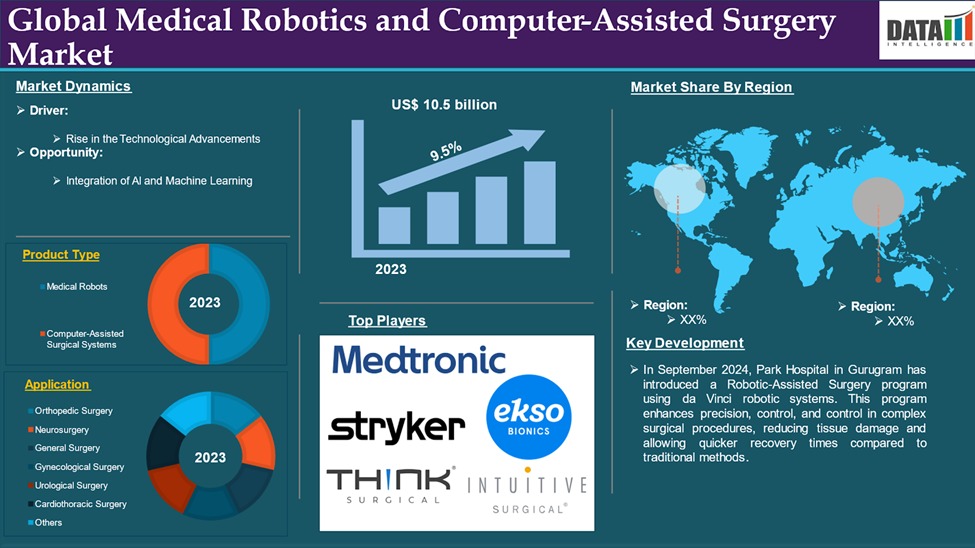
LEANDER, TX, UNITED STATES, February 26, 2026 /EINPresswire.com/ -- The Medical Robotics and Computer-Assisted Surgery Market reached US$ 10.5 billion in 2023 and is projected to reach US$ 23.6 billion by 2033, growing at a CAGR of 9.5 percent from 2025 to 2033. Market growth is driven by the increasing demand for minimally invasive procedures, the rising prevalence of chronic diseases, and growing adoption of precision-based surgical technologies. By integrating advanced robotic systems, high-resolution imaging, and real-time data analytics, these solutions enhance surgical accuracy, reduce complications, shorten hospital stays, and improve overall patient outcomes.— DataM Intelligence
Leading companies are focusing on continuous innovation, integrating artificial intelligence, and forging strategic collaborations to strengthen their market presence. Key players such as Intuitive Surgical and Stryker Corporation are advancing robotic-assisted platforms with enhanced visualization, navigation capabilities, and precision control systems. Increasing hospital investments, supportive regulatory approvals, and expanding adoption across specialties such as orthopedics, cardiology, and urology are further accelerating global market expansion.
Download your exclusive sample report today: (corporate email gets priority access): https://www.datamintelligence.com/download-sample/medical-robotics-and-computer-assisted-surgery-market
Key Developments
February 2026: In North America and Europe, Intuitive Surgical launched next-generation robotic surgical systems with enhanced haptic feedback and AI-assisted image guidance, and expanded clinical training programs to accelerate adoption in major hospital systems.
January 2026: In Europe, Stryker advanced its MAKO robotic arm-assisted surgery platform with improved software workflows for orthopedic procedures and announced broader integration with digital pre-operative planning tools.
December 2025: In Asia Pacific, Medtronic expanded the availability of its robotic-assisted surgical solutions for minimally invasive procedures across key markets including India, China, and Japan, and rolled out clinician support services.
November 2025: In the United States, Johnson & Johnson, through its subsidiary Ethicon, announced enhancements to its robotic surgery portfolio including improved instrument tracking and cloud-connected performance analytics.
October 2025: In global markets, Zimmer Biomet introduced upgraded computer-assisted orthopedic surgical navigation systems featuring expanded anatomical mapping and real-time procedural guidance.
September 2025: In Europe and North America, Surgical Robotics Inc. secured new strategic partnerships with academic medical centers to pilot its compact robotic surgery platforms in general surgery and urology.
Key Segments
By Product Type
Medical robots comprise a broad category including rehabilitation robots, robotic assistive systems, and robotic therapy devices designed to enhance precision and patient recovery outcomes. Computer assisted surgical systems represent a dominant segment, enabling minimally invasive procedures with enhanced visualization, dexterity, and control for surgeons.
By Application
Orthopedic surgery is a leading application area, utilizing robotic systems for joint replacement and spinal procedures requiring high accuracy. Neurosurgery benefits from robotic precision in delicate brain and spinal operations. General surgery incorporates robotic assistance for minimally invasive abdominal procedures. Gynecological surgery uses robotic platforms for hysterectomies and other complex interventions. Urological surgery widely adopts robotic systems for prostate and kidney procedures. Cardiothoracic surgery leverages robotic technologies for heart and lung operations requiring enhanced precision. Other applications include pediatric and colorectal surgeries.
By Component
Hardware accounts for a significant share, including robotic arms, controllers, imaging systems, and surgical instruments. Software plays a critical role in navigation, visualization, data analytics, and procedure planning. Services include system installation, maintenance, training, and technical support, contributing to long term operational efficiency.
By End User
Hospitals represent the largest end user segment due to high patient volumes and investment capacity for advanced surgical infrastructure. Ambulatory Surgical Centers ASCs are increasingly adopting robotic systems to support minimally invasive outpatient procedures. Rehabilitation centers utilize robotic technologies for post operative therapy and recovery programs. Specialty clinics integrate surgical robotics to offer focused treatment services. Pharmacies have limited direct adoption but may support robotic systems in medication dispensing and healthcare automation environments.
Buy Now & Unlock 360° Market Intelligence: https://www.datamintelligence.com/buy-now-page?report=medical-robotics-and-computer-assisted-surgery-market
Key Players
Cyberdyne Inc. | Ekso Bionics | Intuitive Surgical | Lifeward Inc. | Medtronic Plc | Stryker Corporation | Zimmer Biomet | Aurora Surgical Robotics | Xenex Disinfection Services | Vicarious Surgical | Others
Regional Insights
North America – 37% share: “Driven by strong healthcare spending, early adoption of advanced medical technologies, and concentration of leading robotics providers in the United States and Canada.”
Europe – 28% share: “Supported by established healthcare infrastructure, growth in minimally invasive procedures, and increasing deployment of surgical robots across developed markets.”
Asia Pacific – 27% share: “Fueled by rising surgical demand, healthcare modernization, expanding middle-class access, and investments in robotic surgical technologies in China, Japan, India, and Southeast Asia.”
Latin America – 5% share: “Boosted by gradual adoption of robotic surgical systems, increasing surgical volumes, and investments in healthcare capabilities.”
Middle East & Africa – 3% share: “Driven by healthcare infrastructure development, rising demand for advanced care, and early-stage robotics deployments.”
Get Customization in the report as per your requirements: https://www.datamintelligence.com/customize/medical-robotics-and-computer-assisted-surgery-market
Frequently Asked Questions (FAQs):
How big is the global medical robotics and computer-assisted surgery market in terms of growth forecast?
The global medical robotics and computer-assisted surgery market was valued at approximately US$ 10.5 billion in 2023 and is expected to reach around US$ 23.6 billion by 2033, growing steadily during the forecast period.
What is the projected CAGR for the medical robotics and computer-assisted surgery market?
The market is projected to grow at a compound annual growth rate of about 9.5% during the forecast period 2025 to 2033.
Which region currently dominates the medical robotics and computer-assisted surgery market?
North America dominates the medical robotics and computer-assisted surgery market due to advanced healthcare infrastructure, early adoption of robotic surgical systems, and favorable reimbursement policies.
Who are the key players in the global medical robotics and computer-assisted surgery market?
Major companies operating in the market include Intuitive Surgical, Medtronic, Stryker, Zimmer Biomet, Cyberdyne Inc., Ekso Bionics, and Vicarious Surgical.
What are the major drivers of market growth?
The market growth is driven by increasing demand for minimally invasive procedures, technological advancements in robotic systems, integration of AI and imaging technologies, and rising healthcare investments worldwide.
Conclusion:
The global medical robotics and computer assisted surgery market is experiencing significant growth as healthcare providers increasingly integrate advanced robotic systems to enhance surgical precision, minimize invasiveness, and improve patient outcomes. These technologies support surgeons with greater control, flexibility, and accuracy, leading to reduced complications, shorter hospital stays, and faster recovery times. Rising demand for minimally invasive procedures, expanding applications across specialties, and continuous technological advancements are further accelerating market expansion.
Although high installation costs, maintenance expenses, and the need for specialized training may limit adoption in certain regions, ongoing innovation, supportive regulatory frameworks, and growing investments in healthcare infrastructure are expected to drive sustained growth. Overall, medical robotics and computer assisted surgery solutions are poised to play a transformative role in modern healthcare, reshaping surgical practices and improving the quality and efficiency of patient care worldwide.
Related Reports:
1. Surgical robotics market
2. Medical Robotics Market
Sai Kiran
DataM Intelligence 4market Research LLP
+1 877-441-4866
email us here
Visit us on social media:
LinkedIn
YouTube
X
Legal Disclaimer:
EIN Presswire provides this news content "as is" without warranty of any kind. We do not accept any responsibility or liability for the accuracy, content, images, videos, licenses, completeness, legality, or reliability of the information contained in this article. If you have any complaints or copyright issues related to this article, kindly contact the author above.
