

Managed VPN Market to Reach US$ 83.2 Billion by 2033 as Secure Remote Connectivity Demand Surges
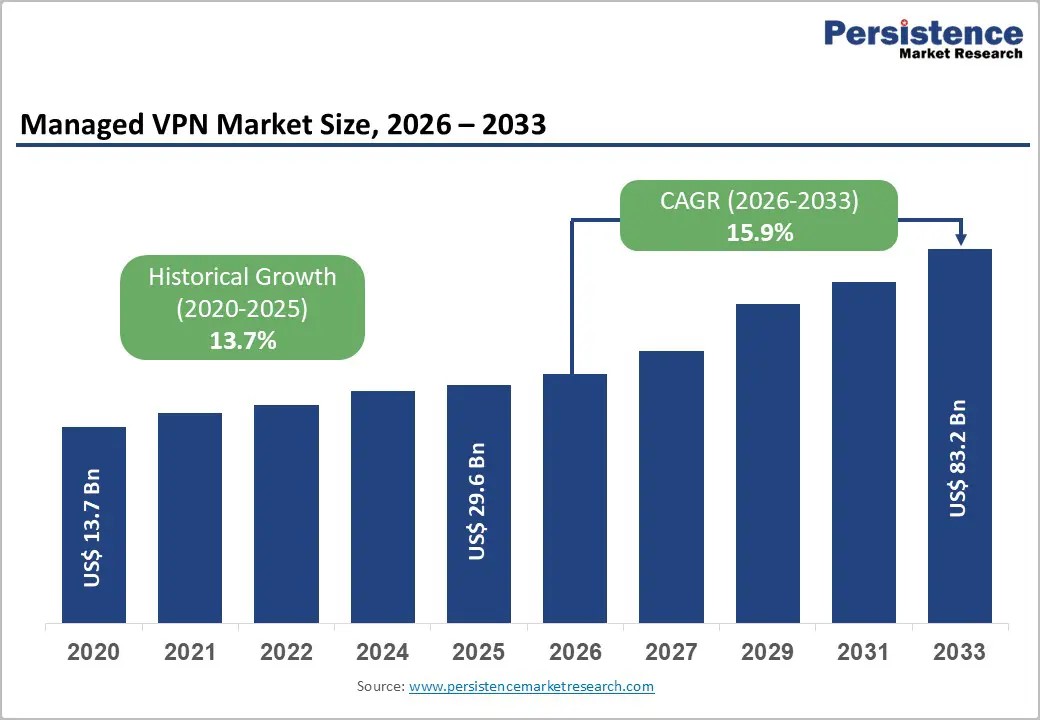
The global managed VPN market is set to grow from US$29.6 Bn in 2026 to US$83.2 Bn by 2033 at a 15.9% CAGR, driven by the rise of hybrid and remote work
BRENTFORD, ENGLAND, UNITED KINGDOM, March 10, 2026 /EINPresswire.com/ -- The Managed VPN Market is witnessing rapid expansion as enterprises increasingly prioritize secure network connectivity in the era of cloud computing, remote work, and digital transformation. The global market is expected to grow from US$ 29.6 billion in 2026 to US$ 83.2 billion by 2033, registering a CAGR of 15.9% during the forecast period. The surge in hybrid work environments, along with rising cybersecurity threats and stricter regulatory compliance standards, is driving enterprises to adopt managed VPN services that provide secure and scalable connectivity without requiring heavy internal IT investments.
Among regional markets, North America leads with approximately 38% share, supported by strong cloud adoption, advanced IT infrastructure, and strict regulatory frameworks in sectors such as healthcare and finance. In terms of market segments, Site-to-Site VPN dominates with around 49% share, as large enterprises rely on secure connectivity between corporate offices, data centers, and global branches. Meanwhile, Asia Pacific is emerging as the fastest-growing region, fueled by rapid digitalization and the expansion of more than 1.6 billion mobile internet users.
𝐆𝐞𝐭 𝐚 𝐒𝐚𝐦𝐩𝐥𝐞 𝐏𝐃𝐅 𝐁𝐫𝐨𝐜𝐡𝐮𝐫𝐞 𝐨𝐟 𝐭𝐡𝐞 𝐑𝐞𝐩𝐨𝐫𝐭: https://www.persistencemarketresearch.com/samples/14368
Market Segmentation Analysis
The managed VPN market can be segmented based on VPN type, distribution channel, and end-user industries, each contributing significantly to overall demand. By VPN type, Site-to-Site VPN solutions dominate the market, as enterprises rely on secure encrypted tunnels to connect multiple office locations, data centers, and branch networks. These VPNs enable continuous connectivity between corporate locations while minimizing administrative complexity and ensuring consistent access to centralized applications and databases.
From a distribution perspective, Managed Service Providers (MSPs) represent the leading distribution channel, accounting for about 38% market share. Organizations prefer MSPs because they offer comprehensive services such as network monitoring, VPN deployment, security updates, compliance reporting, and ongoing technical support. End-user industries include IT & ITES, banking and financial services, healthcare, government, and manufacturing, with the IT and ITES sector holding the largest share due to its reliance on secure global connectivity and distributed workforce operations.
Regional Insights
North America remains the leading regional market for managed VPN solutions due to its mature IT ecosystem, high enterprise technology spending, and strict compliance regulations such as HIPAA and PCI-DSS. Enterprises across the United States and Canada are investing heavily in managed security services to protect sensitive data and maintain secure remote access to business applications.
Asia Pacific is projected to be the fastest-growing region in the managed VPN market. Rapid digital transformation, increasing mobile internet penetration, and expanding cloud infrastructure in countries such as India, China, and Southeast Asian nations are fueling the demand for secure managed network services.
𝐃𝐨 𝐘𝐨𝐮 𝐇𝐚𝐯𝐞 𝐀𝐧𝐲 𝐐𝐮𝐞𝐫𝐲 𝐎𝐫 𝐒𝐩𝐞𝐜𝐢𝐟𝐢𝐜 𝐑𝐞𝐪𝐮𝐢𝐫𝐞𝐦𝐞𝐧𝐭? 𝐑𝐞𝐪𝐮𝐞𝐬𝐭 𝐂𝐮𝐬𝐭𝐨𝐦𝐢𝐳𝐚𝐭𝐢𝐨𝐧 𝐨𝐟 𝐑𝐞𝐩𝐨𝐫𝐭: https://www.persistencemarketresearch.com/request-customization/14368
Market Drivers
The growing adoption of remote and hybrid work models is one of the primary factors driving the managed VPN market. As organizations shift toward distributed work environments, employees require secure remote access to corporate networks and cloud applications. Managed VPN services enable enterprises to maintain encrypted connections and enforce centralized security policies across multiple devices and locations.
Another major driver is the integration of VPN solutions with Zero Trust Network Access (ZTNA) and Secure Access Service Edge (SASE) frameworks. These next-generation security architectures allow organizations to move away from traditional perimeter-based security models and adopt identity-driven access controls that enhance data protection in cloud-native environments.
Market Restraints
Despite significant growth prospects, the managed VPN market faces challenges related to skill shortages and operational complexity. Deploying advanced network security solutions often requires specialized expertise in cybersecurity, SD-WAN, and cloud networking. Many organizations, particularly small and medium-sized businesses, lack the internal technical resources needed to manage complex VPN deployments effectively.
Another constraint is the increasing complexity of regulatory and privacy compliance requirements. Governments and regulatory bodies worldwide are introducing stricter data protection laws that impose additional obligations on VPN providers regarding data storage, encryption standards, and audit logging. These regulatory pressures can increase operational costs and limit service deployment in certain regions.
Market Opportunities
The rapid adoption of managed network services among small and medium-sized enterprises (SMEs) represents a major growth opportunity for the managed VPN market. SMEs are increasingly embracing subscription-based network security solutions that eliminate the need for large upfront investments in infrastructure. Managed VPN providers are leveraging Network-as-a-Service (NaaS) models to deliver enterprise-grade security capabilities at affordable pricing.
Additionally, the integration of artificial intelligence and machine learning into managed VPN platforms offers significant potential for market expansion. AI-powered threat detection systems can identify unusual network patterns, detect encrypted malware, and automate security responses in real time. These advanced capabilities improve network security and enable organizations to proactively prevent cyberattacks.
𝐁𝐮𝐲 𝐍𝐨𝐰 𝐭𝐡𝐞 𝐃𝐞𝐭𝐚𝐢𝐥𝐞𝐝 𝐑𝐞𝐩𝐨𝐫𝐭: https://www.persistencemarketresearch.com/checkout/14368
Company Insights
The managed VPN market is characterized by a competitive landscape that includes telecom providers, cloud infrastructure companies, and cybersecurity technology vendors. Leading players are focusing on integrating VPN services with advanced security technologies such as SASE, SD-WAN, and AI-powered threat detection platforms to deliver comprehensive network security solutions.
Key Players Operating in the Managed VPN Market:
AT&T Inc.
Cisco Systems, Inc.
BT Group PLC
CenturyLink, Inc.
Vodafone Group Plc
Verizon Communications Inc.
Orange Business Services SAS
Tata Communications Ltd.
NTT Corporation
Telefónica, S.A.
Palo Alto Networks Inc.
Microsoft Corporation (Azure)
IBM Corporation
Fortinet Inc.
Juniper Networks Inc.
Recent Developments
In September 2025, Palo Alto Networks launched Prisma SASE 4.0, featuring AI-driven browser protection and integrated security capabilities. The platform’s annual recurring revenue from SASE services reached US$ 1.3 billion, reflecting strong enterprise demand.
In August 2023, Verizon partnered with HCLTech to expand global managed network services, supporting enterprise deployments of 5G, SD-WAN, and SASE architectures to improve secure connectivity for global organizations.
Related Reports:
Pooja Gawai
Persistence Market Research
+1 646-878-6329
email us here
Visit us on social media:
LinkedIn
Instagram
Facebook
YouTube
Legal Disclaimer:
EIN Presswire provides this news content "as is" without warranty of any kind. We do not accept any responsibility or liability for the accuracy, content, images, videos, licenses, completeness, legality, or reliability of the information contained in this article. If you have any complaints or copyright issues related to this article, kindly contact the author above.
