

PEO Model Enables Small Employers to Access Enterprise-Level Benefits Packages
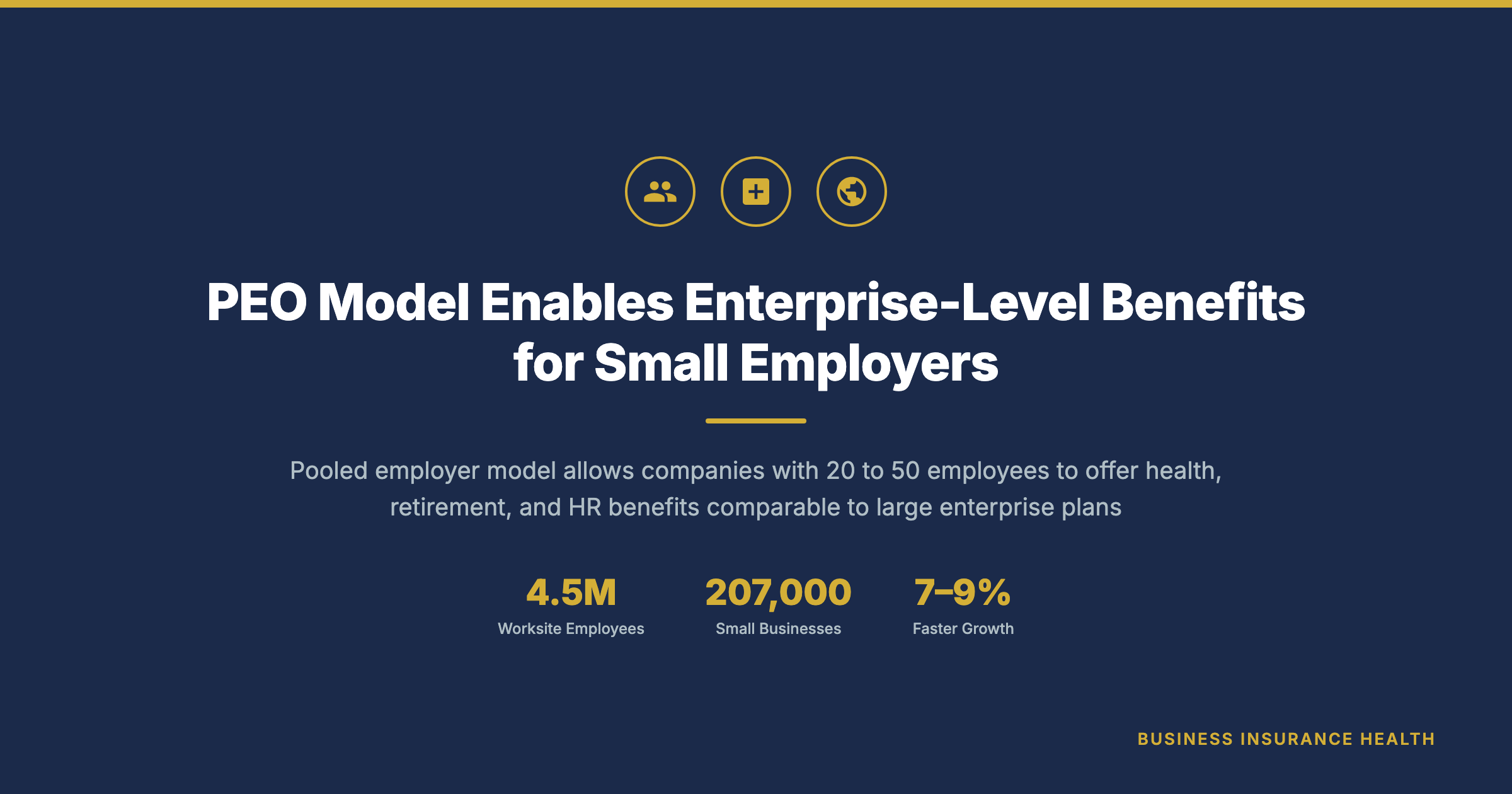
Professional Employer Organizations pool hundreds of small employers to negotiate health, retirement, and HR benefits at enterprise scale, with NAPEO data showing 4.5 million worksite employees across 207,000 businesses.
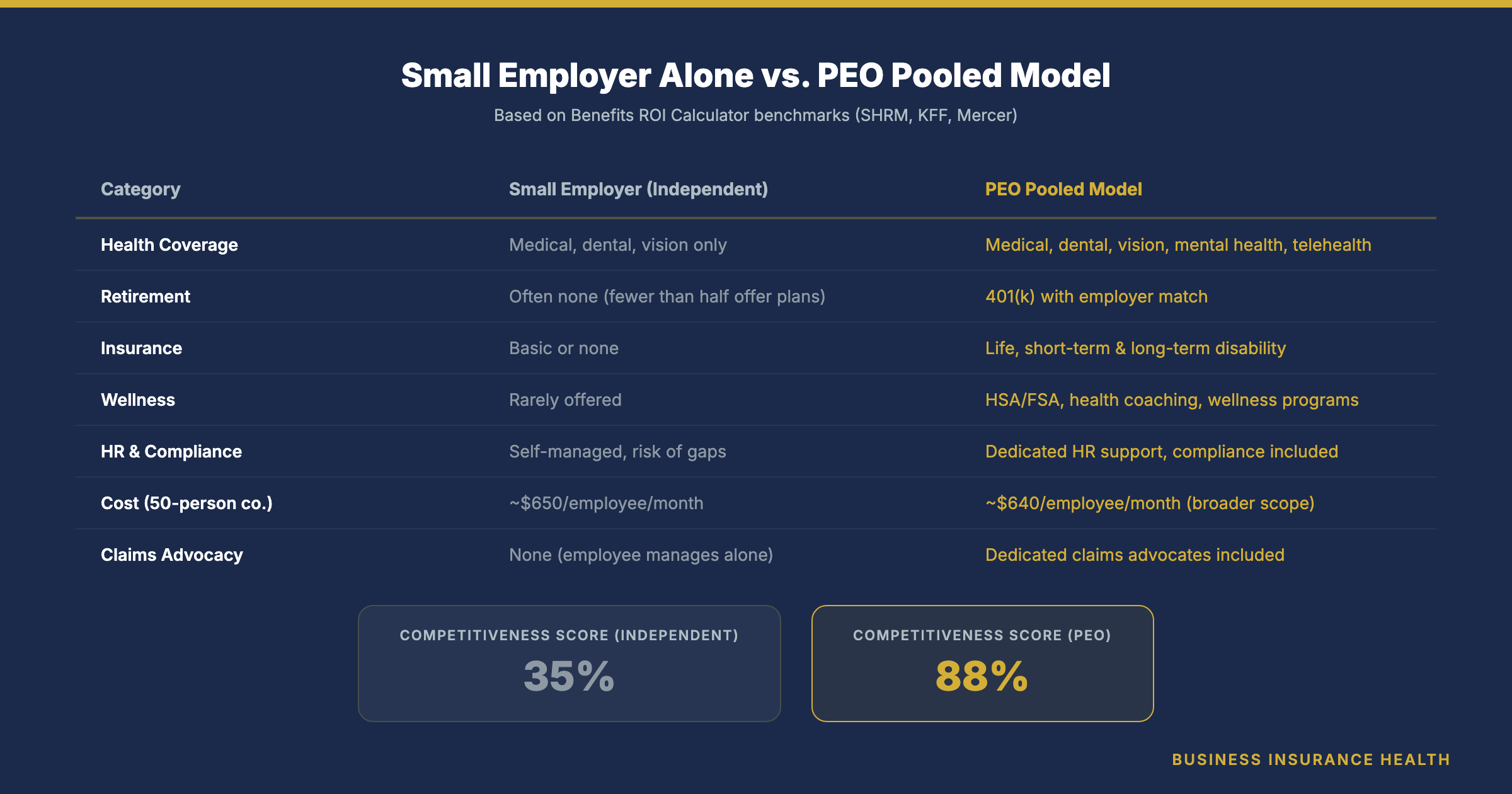
Benefits ROI Calculator comparison showing a 40-person firm scoring 35 percent competitiveness independently versus 88 percent with a PEO benefits package, based on SHRM, KFF, and Mercer benchmarks.
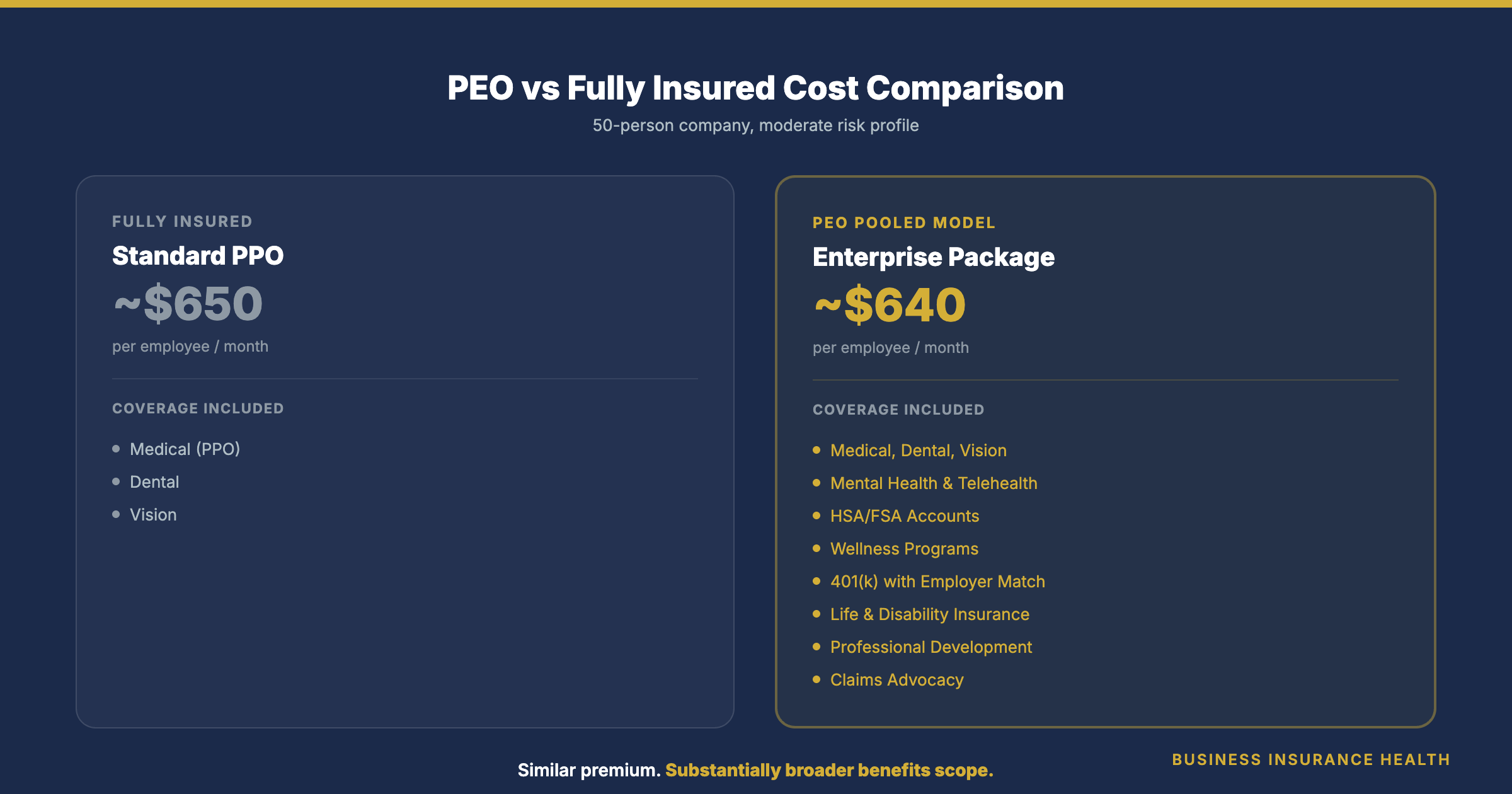
Cost comparison for a 50-person company showing approximately $650 per employee per month fully insured versus $640 per employee per month through a PEO, with substantially broader benefits scope in the PEO arrangement.
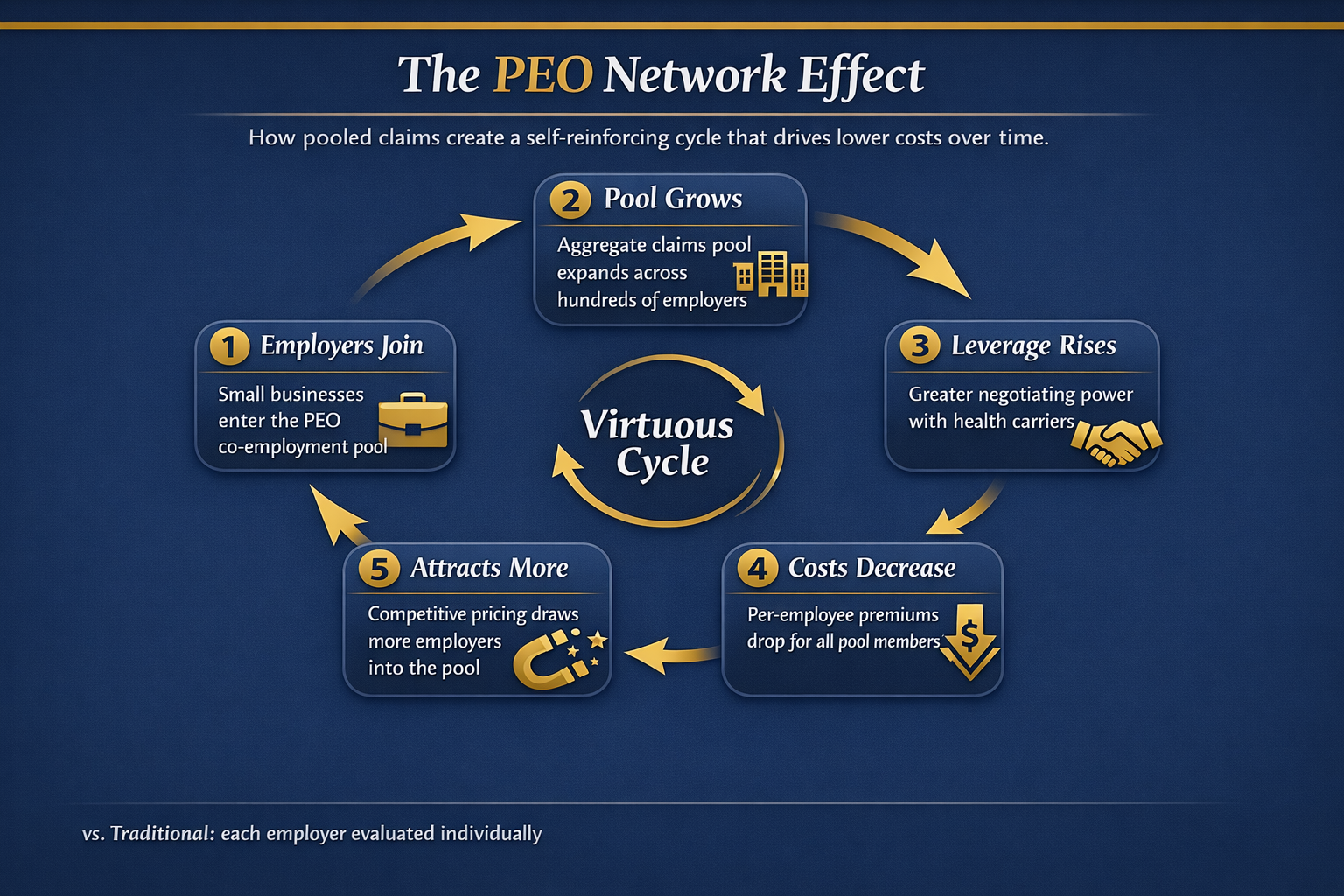
Diagram showing the PEO network effect cycle: more employers join the pool, aggregate claims pools grow, negotiating leverage increases, per-employee costs decrease, and pricing becomes more competitive.
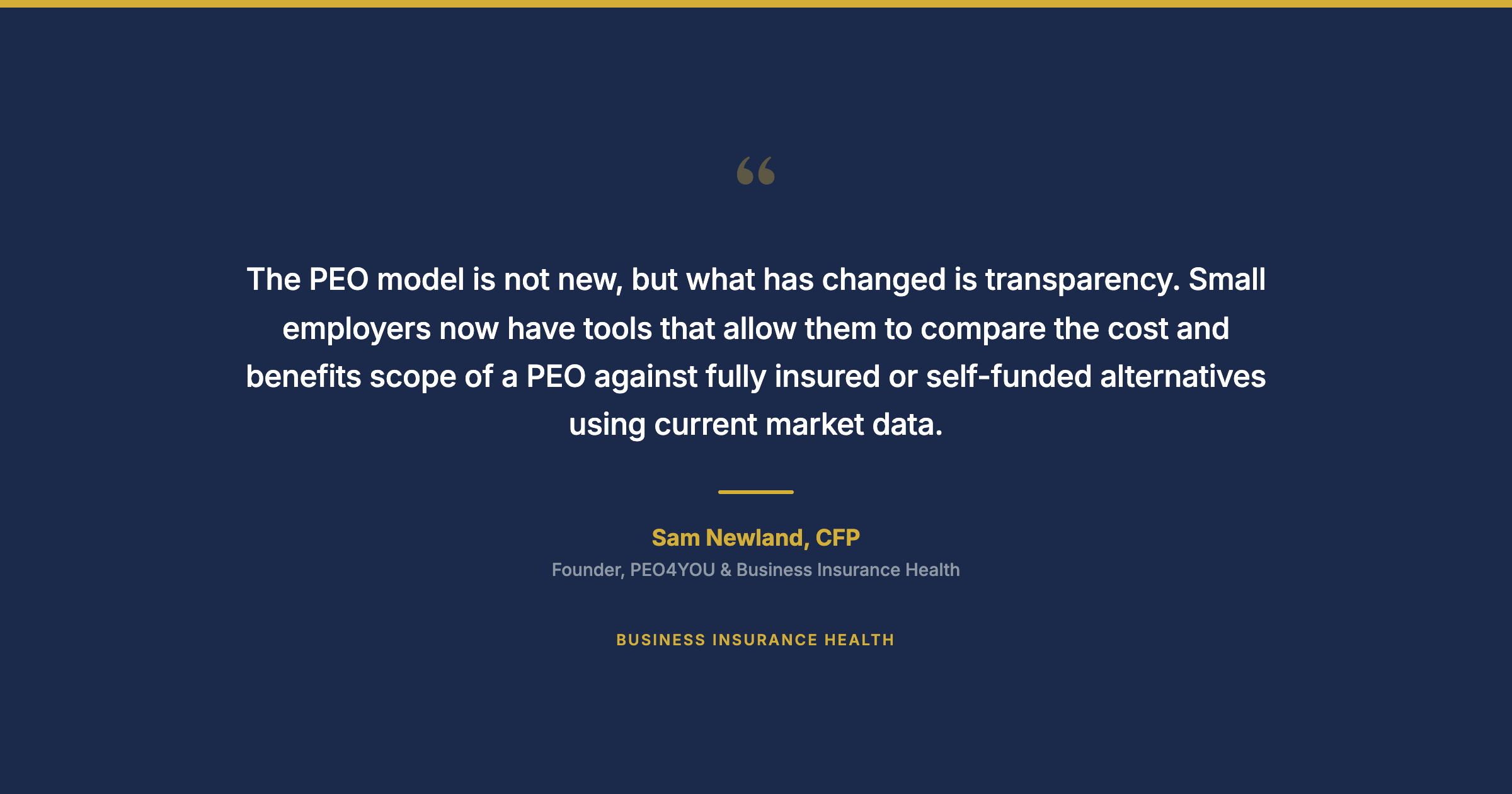
Sam Newland, CFP, founder of PEO4YOU and Business Insurance Health, on how data transparency is changing the way small employers evaluate PEO arrangements.
Pooled employer model allows companies with 20 to 50 employees to offer health, retirement, and HR benefits comparable to large enterprise plans
BOSTON, MA, UNITED STATES, April 10, 2026 /EINPresswire.com/ -- A growing number of small employers are using Professional Employer Organizations (PEOs) to offer benefits packages that were previously available only through large enterprise plans. By pooling the HR and benefits risk of hundreds of small companies, PEOs (https://businessinsurance.health/peo-service/) negotiate group health insurance, retirement plans, and ancillary benefits at scale, passing those rates and plan options to their client employers.
Industry Context
The PEO industry has grown steadily over the past two decades. According to the National Association of Professional Employer Organizations (NAPEO), PEOs now co-employ approximately 4.5 million worksite employees across the United States, representing roughly 207,000 small and mid-size businesses. NAPEO research indicates that small businesses using PEOs grow 7 to 9 percent faster, have 10 to 14 percent lower employee turnover, and are 50 percent less likely to go out of business compared to peers that do not use PEOs.
At the same time, small business benefits trends have shifted. According to KFF's 2025 Employer Health Benefits Survey, small firms (3 to 199 workers) continue to face higher per-employee premium costs than large firms, and fewer than half offer retirement plans. SHRM data shows that benefits comprehensiveness is now a top-three factor in employee retention decisions. These dynamics have made pooled-employer models increasingly relevant for companies in the 10-to-100-employee range. Employers can explore options by state, including Illinois (https://peo4you.com/illinois-health-plan/) and other states through the nationwide coverage hub (https://peo4you.com/nationwide-health-plan-coverage/).
The Competitiveness Gap
Business Insurance Health's Benefits ROI Calculator (https://businessinsurance.health/benefits-roi-calculator/) quantifies the difference between what a small employer offers independently and what a PEO arrangement provides. The tool sources its benchmarks from SHRM, KFF, and Mercer data on benefits comprehensiveness in 2026 and allows employers to select from 42 benefits across eight categories.
A 40-person accounting firm that offers only health insurance, dental, and vision might score approximately 35 percent on the tool's competitiveness index. When the same firm models a full PEO benefits package — medical, dental, vision, mental health, telehealth, HSA/FSA, health coaching, wellness programs, 401(k) with employer match, life insurance, disability insurance, EPLI coverage, employee assistance programs, professional development funding, flexible schedules, and additional voluntary benefits — the competitiveness score increases to approximately 88 percent.
That difference, from 35 percent to 88 percent, reflects a measurable gap in benefits breadth. Research from SHRM and Mercer suggests that benefits competitiveness of this magnitude correlates with improved retention rates and stronger recruiting outcomes, particularly in competitive labor markets.
The Cost Comparison
A common assumption among small employers is that more comprehensive benefits require significantly higher premiums. PEO pricing data suggests otherwise in many cases. Because PEOs pool claims risk across hundreds of employers, they can smooth claims volatility and negotiate rates that are competitive with — or in some cases lower than — fully insured small-group plans.
As an example, a 50-person company in a moderate risk profile using a fully insured plan might pay approximately $650 per employee per month for a standard PPO. A comparable PEO arrangement with a broader benefits package might cost approximately $640 per employee per month. The premium is similar, but the benefits scope is substantially wider — adding dental, vision, mental health, telehealth, HSA/FSA accounts, wellness programs, a 401(k), life insurance, disability insurance, and professional development funding.
The Premium Renewal Stress Test (https://businessinsurance.health/businessinsurance-stress-test/) tool on the Benefits Intelligence Platform (https://businessinsurance.health/) models these cost trajectories over six-year periods, allowing employers to compare projected PEO costs against projected fully insured renewal trends.
Claims Advocacy
One component of the PEO model that does not appear in standard benefits comparisons is claims advocacy. PEO clients typically have access to dedicated benefits coordinators and claims advocates who assist employees with insurance navigation, denial appeals, bill negotiation, and connections to patient assistance programs.
In a fully insured arrangement, employees generally manage claims disputes independently or rely on internal HR staff. In a PEO arrangement, claims advocacy is included as part of the co-employment model and is handled by trained professionals.
The Network Effect
As more small employers join PEOs, the aggregate claims pools grow. Larger pools provide greater negotiating leverage with health carriers and providers, which may lead to lower per-employee costs over time. Lower costs allow PEOs to offer more competitive pricing, which attracts additional employers into the pool. This cycle differs from traditional fully insured arrangements, where each employer's claims history is evaluated individually and renewal pricing reflects that company's experience alone.
In the PEO model, all employers in the pool benefit from the aggregate claims experience and collective bargaining position of the entire group.
"The PEO model is not new, but what has changed is transparency," said Sam Newland, CFP, founder of PEO4YOU (https://peo4you.com/) and Business Insurance Health. "Small employers now have tools that allow them to compare the cost and benefits scope of a PEO against fully insured or self-funded alternatives using current market data. When they complete that comparison, many find that the PEO option offers broader coverage at a competitive price point."
ABOUT PEO4YOU / BUSINESS INSURANCE HEALTH
PEO4YOU, in partnership with Business Insurance Health, is a Boston-based independent benefits consulting firm founded by Sam Newland, CFP. The firm provides coverage in Illinois and nationwide, helping small and mid-size employers access enterprise-level benefits, HR support, and cost-reduction strategies through PEOs, self-funded and level-funded health plans, captive insurance, and Taft-Hartley trusts. Its Benefits Intelligence Platform at businessinsurance.health provides employers with actuarial-grade modeling tools. PEO4YOU is part of the Newland Group Insurance family of companies and contributes to a medical debt forgiveness initiative with every client engagement.
SAMUEL DAVID NEWLAND
PEO4YOU
+1 857-255-9394
email us here
Visit us on social media:
LinkedIn
Instagram
Facebook
YouTube
X
Legal Disclaimer:
EIN Presswire provides this news content "as is" without warranty of any kind. We do not accept any responsibility or liability for the accuracy, content, images, videos, licenses, completeness, legality, or reliability of the information contained in this article. If you have any complaints or copyright issues related to this article, kindly contact the author above.
