

Contact Lens Import Compliance in 2026: A 10-Country Compliance Map from Constar
This 10-country map is organized into quick-reference entries so distributors and brand owners can compare requirements at a glance and prioritize the certification work that unlocks their target markets.
Contact Lens Import Compliance at a Glance
Local representative is mandatory in most markets — EU, UK, China, Japan, Australia, Canada, India and South Korea all require a local agent, sponsor, MAH or Responsible Person.
One approval never covers another market. CE, FDA, TGA and CDSCO each run independent assessments.
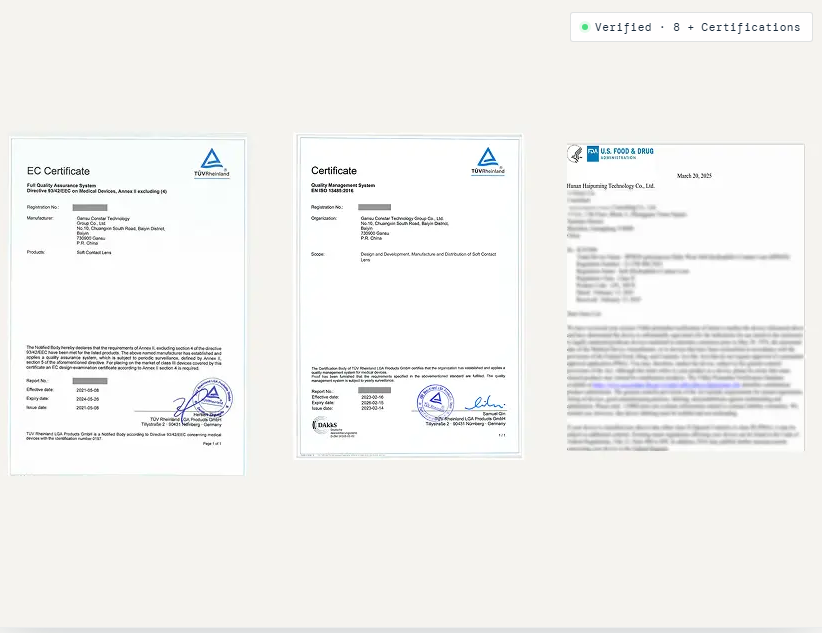
Certification breadth is the real competitive advantage — fewer than a handful of global factories hold FDA, CE 0197 and ISO 13485 simultaneously.
Prescription rules vary by market but lean to mandatory — most regulated economies require a valid prescription for all lenses, cosmetic lenses included.
1. United States — FDA (Class II / 510(k))
Lenses fall under 21 CFR Part 886 and require establishment registration, device listing and premarket clearance via the 510(k) pathway — or full PMA for higher-risk products. Foreign manufacturers must appoint a US Agent, and a valid prescription is required for all lenses under the FDA Contact Lenses program and the FTC Contact Lens Rule. Clinical data is typically needed in only about 10% of 510(k) submissions, which keeps the US pathway comparatively fast for conventional lenses.
2. European Union — CE Marking under MDR 2017/745
Since May 2021, lenses need a CE mark assessed by an independent notified body under Medical Device Regulation (EU) 2017/745 — see the official regulation text at EUR-Lex. Lenses are typically Class IIa/IIb; the optical-device notified body designation CE 0197 is held by only a small number of organizations worldwide. Non-EU manufacturers must appoint an EU Authorized Representative, maintain technical documentation for 10 years, and comply with UDI requirements (mandatory since 2021) and post-market surveillance under Article 61.
3. United Kingdom — MHRA / UKCA
Post-Brexit, lenses entering Great Britain require UKCA marking (with CE transition still in effect for many products) and MHRA registration before market placement. A UK Responsible Person is mandatory for manufacturers based outside the UK, and prescriptions are enforced by optometrists under existing practice frameworks.
4. China — NMPA (Class III)
China treats contact lenses as Class III devices, its highest-risk category, regardless of the class assigned in the country of origin. Requirements include NMPA registration, in-country type testing (only biocompatibility per ISO 10993 / GB 16886 is accepted from abroad), a mandatory local agent, and proof of home-market approval. Full registration is typically a multi-year, six-figure exercise.
5. Japan — PMDA / MHLW
Under Japan's PMD Act, lenses are classified at Class II or III and require marketing authorization through the Pharmaceuticals and Medical Devices Agency (PMDA). Foreign manufacturers must appoint a Japan-based Marketing Authorization Holder (MAH), hold Japanese QMS (J-QMS) audits, and work through a registered certification body for Class II devices.
6. Australia — TGA (ARTG)
Lenses are Class IIa/IIb devices requiring ARTG inclusion before sale, with a mandatory Australian local sponsor that holds legal responsibility. Advertising of contact lenses to the public is restricted, so marketing must run through the practitioner channel.
7. Canada — Health Canada
Health Canada regulates lenses as Class II/III devices requiring a Medical Device License (Class III), plus an Establishment License for importers and distributors. An ISO 13485 quality system is effectively required to demonstrate compliance.
8. Saudi Arabia — SFDA
The Saudi Food and Drug Authority (SFDA) requires product registration before lenses can be imported across GCC markets, with Arabic-language labeling and documentation mandatory for customs clearance. Lenses are increasingly treated under full medical-device registration rules as the region's beauty optics demand grows.
9. India — CDSCO (MDR 2017)
India's regulatory net closed around all medical devices in 2026. Importing agencies must hold a CDSCO import license (Forms MD-14 / MD-15) via the SUGAM portal, and contact lenses now require mandatory BIS certification under IS 15923. Foreign manufacturers must appoint an Indian Authorized Agent (IAA), supply a Free Sale Certificate from the country of origin (not older than 2 years), and demonstrate ISO 13485. Registration typically takes 6–12 months.
10. South Korea — MFDS
Lenses are Class II/III under the Ministry of Food and Drug Safety (MFDS), requiring preliminary KFDA/MFDS approval before import. A licensed local importer is mandatory, Korean-language labeling is required, and documentation must be submitted in Korean.
Southeast Asia: A Patchwork Within a Region
Southeast Asia is the least uniform region. Indonesia requires AKL approval; Vietnam uses a tiered system assigning lenses to Class B with a different dossier than Class A; Thailand's TFDA requires product registration plus a local representative; Malaysia enforces its own Medical Device Authority standards. Suppliers with region-specific certifications — like the multi-market compliance portfolio Constar maintains across 40+ countries, spanning FDA, CE 0197, TGA, SFDA, AKL and Vietnam Class B — remove the need to source from different factories for different geographies.
What Distributors Should Verify Before Placing an Order
Market-specific certifications, not one general credential. A CE mark alone does not satisfy an FDA, NMPA or CDSCO, and vice versa.
Batch-level documentation. Request Certificates of Analysis, biocompatibility test reports and material safety data sheets with every shipment.
A proven customs track record. Established manufacturers will have documented processes for import clearance in your target region — the difference between a clean landing and a seized container.
Frequently Asked Questions
Is a CE mark enough to import contact lenses into any country?
No. CE marking only covers the European Economic Area. The US FDA, China's NMPA, Japan's PMDA, India's CDSCO and every other major regulator run independent assessments, and most also require a local representative for the importing manufacturer.
Do all countries require contact lens import registration?
In any regulated market, yes. Contact lenses are classified as medical devices, so registration or authorization is required before import — plus, in most markets, a doctor-issued prescription to sell them. Markets without such controls are where counterfeit and unapproved lenses circulate.
Why do contact lens compliance requirements change so often?
Because medical device rules are continuously tightening — from the EU MDR 2017/745 to China's NMPA Class III regime to India's 2026 mandatory BIS certification (IS 15923). Buyers should re-verify compliance requirements annually before renewing supplier contracts.
About Constar
Gansu Constar Technology Group Co., Ltd. is a China-based contact lens OEM and ODM manufacturer serving brands and distributors in more than 40 countries. Founded more than 40 years ago and headquartered in Baiyin, Gansu Province, the company operates six production facilities with a combined capacity of over 15 million lenses per month, and holds US FDA (510(k), Class II), EU CE 0197 (MDR), ISO 13485, TGA, SFDA, AKL and Class B (Vietnam) certifications.
Sources:
FDA — Contact Lenses (Medical Devices Program)
EUR-Lex — Medical Device Regulation (EU) 2017/745
CDSCO — Medical Device Rules 2017 (Forms MD-14 / MD-15)
Constar — Markets We Serve
Gansu Constar
Gansu Constar Technology Group CO.,LTD
+852 91218475
info@constarfactory.com
Legal Disclaimer:
EIN Presswire provides this news content "as is" without warranty of any kind. We do not accept any responsibility or liability for the accuracy, content, images, videos, licenses, completeness, legality, or reliability of the information contained in this article. If you have any complaints or copyright issues related to this article, kindly contact the author above.
