

Festive Lights Examines the Shift to Connectable Icicle Lighting for Roofline Displays
News originally published by
EIN Presswire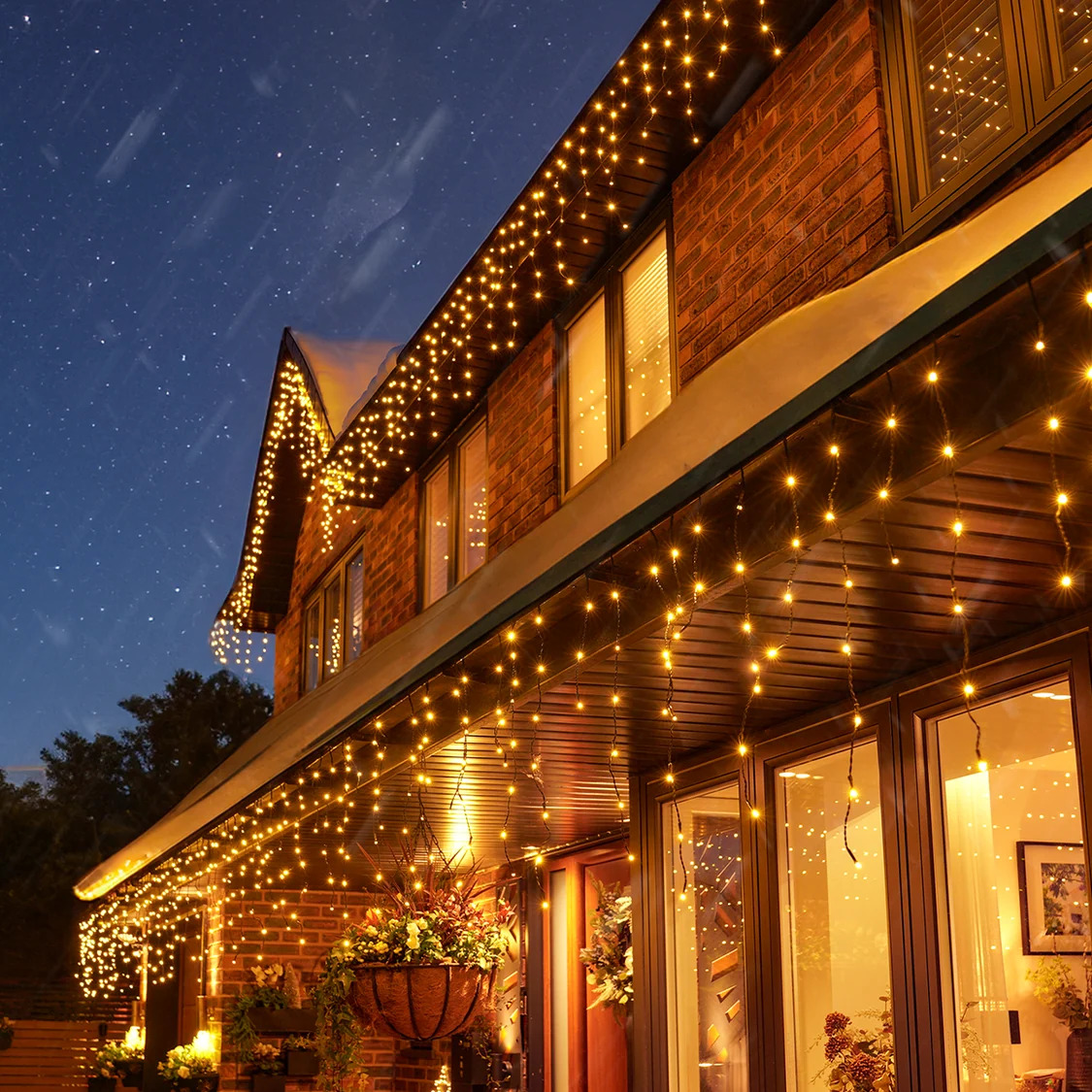
Icicle lights

An overview from the supplier sets out how the lighting of eaves and gutters has moved from short individual sets to long connectable runs.
CHORLEY, CHARNAROCK RICHARD, UNITED KINGDOM, November 11, 2026 /EINPresswire.com/ -- Festive Lights, a United Kingdom-based supplier of domestic and commercial decorative lighting, has published an overview of how households and businesses light the rooflines of buildings for the festive season, focusing on the shift from short, individually plugged icicle sets to long connectable runs that trace the full edge of a structure. The assessment examines the design of icicle lighting, the engineering that allows extended runs to be driven from a single supply point, and the weatherproofing required at the most exposed part of a building, drawing a distinction between the systems specified for domestic use and those intended for commercial installation.The roofline occupies a particular position in exterior festive lighting. The eaves, gutters and gable edges of a building form its most prominent horizontal lines, and outlining them defines the shape of the property against the dark in a way that ground-level or garden lighting cannot. Icicle lighting, in which strands of varying length hang downward from a horizontal cable to suggest hanging ice, has become the format most associated with this application, and the overview traces how its practical use has changed as connectable systems have replaced the short sets that once limited what a household could install.
From Short Sets to Continuous Runs
For much of the period in which domestic exterior lighting was common, icicle lighting was sold in short sets, each terminating in its own plug. Lighting a full roofline therefore required either multiple outdoor sockets, which few properties possess, or a series of extension leads, an arrangement that was both visually untidy and electrically inadvisable. The length of a display was constrained less by the design of the building than by the availability of power, and continuous illumination along an entire eave was difficult to achieve.
The introduction of connectable systems removed that constraint. Modern icicle lights are designed so that multiple lengths can be joined end to end and driven from a single supply point, allowing a continuous run to follow the full perimeter of a roofline without additional sockets or trailing leads. This has shifted the determining factor in a display from the position of the nearest socket to the dimensions of the building itself, and has made the even outlining of a complete roofline a routine rather than an exceptional installation.
Two categories of connectable system have emerged to serve different requirements. For domestic installations, ConnectGo icicle lights use a lighter clear or black cable and strands of varying drop length, typically staggered between about thirty and seventy centimetres, which produces the irregular, natural appearance that suits a house frontage. For larger and more demanding installations, ConnectPro icicle lights use a heavy-duty rubber cable and support longer total runs, extending to as much as one hundred metres from a single starting point, a specification associated with commercial frontages, retail sites and public buildings where scale and durability take precedence.
"The move to connectable systems changed the question people ask," said Stephen Alty, General Manager at Festive Lights. "It used to be how many sockets are available and how far the display can reach before the leads become a problem. Now the question is simply how long the roofline is, and the lighting is specified to match. That is a significant practical shift, because it means the building determines the display rather than the wiring, and it is the main reason continuous roofline lighting has become so much more common."
The Engineering of a Long Run
The ability to drive a long run from a single point introduces an engineering requirement that the overview identifies as central to the performance of icicle lighting: the management of voltage drop. As current travels along a cable, the natural resistance of the conductor causes a gradual fall in voltage, with the result that fixtures towards the end of a long run can appear dimmer than those near the supply. On a roofline, where the whole length is visible at once, any such unevenness is immediately apparent and undermines the effect of a continuous line.
Connectable systems address this through the gauge and quality of the conductor and through the design of the circuit, using thicker wiring and controlled run lengths to maintain an even output from the first fixture to the last. The overview notes that the maximum run a manufacturer specifies for a given system is set with this in mind, and that exceeding it is the most common cause of uneven brightness. The guidance is to plan a roofline run within the stated limit and, for very long perimeters, to divide the installation into separate runs rather than extending a single one beyond its design length.
The form of the lighting itself also reflects deliberate design. The varying drop lengths that characterise icicle lighting are intended to break the regularity of a straight line and suggest the irregularity of hanging ice, and the overview notes that staggered drops produce a more natural domestic appearance while uniform drops produce the neater, more formal line often preferred for commercial frontages. The choice between them is presented as an aesthetic decision rather than a technical one, with both served by the same connectable architecture.
Weatherproofing at the Most Exposed Point
The roofline is the most environmentally exposed part of a building, and lighting installed there is subject to the full force of winter weather, including driving rain, wind and freezing temperatures, with little of the shelter afforded to lighting at ground level. The overview emphasises that the reliability of a roofline display depends on weatherproofing specified for these conditions, expressed through the Ingress Protection (IP) rating that defines a product's resistance to water and dust.
Icicle lighting intended for roofline use is rated for outdoor installation, and the overview advises confirming the stated rating before purchase, since the consequences of water ingress are greater at the eaves than almost anywhere else on a property. The construction associated with weather-rated systems, including sealed connectors, durable cabling and robust strand fixings, is identified as the factor that determines whether an installation survives a full season at the roofline. The heavier rubber cabling used in commercial-grade systems is noted as providing additional resilience for installations that remain in place across an extended period or in particularly exposed positions.
"The roofline asks more of a product than anywhere else on the building," said Jana Dalton, a specialist in exterior lighting at Festive Lights. "It is high, it is exposed, and it is the one place nobody wants to revisit mid-season to deal with a fault. That is why the specification matters so much there. A properly rated set with sealed connectors and good cable will see out the winter, and the time to establish that is before it goes up, not after a section fails in December."
Installation and Safe Working at Height
The overview addresses the practical considerations of installing lighting at the roofline, where working at height introduces a safety dimension absent from ground-level displays. The guidance is to plan the installation from the ground, measuring the run and preparing the lengths before any work at height begins, and to use appropriate access equipment on stable footing rather than improvised arrangements. Fixing is addressed through purpose-made clips that attach to gutters, fascia or tiles without piercing cabling or insulation, which hold the horizontal line securely while allowing the strands to hang freely.
The overview notes that planning the full run in advance, including the position of the supply point and the direction of the run, reduces the time spent working at height and the likelihood of needing to make adjustments once the lighting is in place. For installations beyond the reach or confidence of a household, and for commercial displays in particular, it identifies professional installation as the appropriate course, noting that commercial roofline lighting in public spaces carries obligations for safe installation and inspection that do not apply to a domestic display.
Domestic and Commercial Scale
The distinction between domestic and commercial roofline lighting runs through the overview as a matter of specification rather than of appearance. Domestic installations typically outline the eaves and gable of a single property, using lighter connectable systems sized to a house frontage and chosen for a natural, staggered look. Commercial installations extend the same principle to larger buildings, terraces and high-street frontages, using heavier systems that support longer runs and withstand more demanding exposure, and are frequently installed and maintained professionally.
The overview notes that the connectable architecture common to both allows an installation to be extended or reconfigured over time, so that a display can grow with a building's requirements or be adapted as a frontage changes. This modularity is identified as a characteristic that distinguishes connectable icicle systems from the fixed sets they have replaced, allowing both households and operators to treat roofline lighting as an installation that can be built up and maintained rather than replaced wholesale.
Energy Use and Running Cost
As with decorative lighting generally, the running cost of a roofline display has fallen with the transition to LED technology, which draws a small fraction of the power consumed by the incandescent sets it has replaced. The overview notes that a roofline run, despite its length, operates at a modest cost over a season when built from LED fixtures, and that the low power draw of LEDs is itself a factor in the viability of long connectable runs, since it allows an extended run to be driven from a single supply without exceeding its electrical limits. Timers and controls are identified as the means by which a household limits operation to the evening hours, reducing both cost and wear.
Market Context and Outlook
The overview situates the growth of roofline lighting within the wider expansion of exterior festive displays, in which connectable systems, LED efficiency and improved weatherproofing have together made continuous architectural outlining accessible to households that would once have been limited to a short set beside a door. The treatment of the building's own lines as the framework for a display is identified as an established pattern that connectable icicle lighting has made straightforward to achieve.
Festive Lights states that its overview is intended to help households and operators approach roofline lighting as a planned installation, matched to the dimensions of the building and specified for the exposure of the eaves, rather than as an assembly of short sets constrained by the position of a socket. The company notes that the appropriate system depends on the scale of the installation and the conditions it must withstand, and that run length, weatherproofing and safe installation are the considerations common to any roofline display.
About Festive Lights
Festive Lights is a United Kingdom-based supplier of exterior and interior decorative lighting, focusing on the distribution of connectable LED string and festoon systems, solar-powered fixtures, battery-operated lighting, application-controlled smart lighting and motion-sensor units for residential and commercial use. The company supplies both consumers and professional installers and manufactures its products to defined weatherproofing standards. Established for over two decades and based in Charnock Richard, Chorley, the organisation maintains an emphasis on product durability, weatherproofing certification and accessible installation.
Jana Dalton
Festive Lights
Visit us on social media:
LinkedIn
Instagram
Facebook
YouTube
TikTok
X
Other
Legal Disclaimer:
EIN Presswire provides this news content "as is" without warranty of any kind. We do not accept any responsibility or liability for the accuracy, content, images, videos, licenses, completeness, legality, or reliability of the information contained in this article. If you have any complaints or copyright issues related to this article, kindly contact the author above.
